
Why Your Revenue Strategy Never Reaches the Frontline and How to Fix It
The blog post titled "Why Your Revenue Strategy Never Reaches the Frontline and How to Fix It," published on November 17, 2026, discusses the common issue of revenue strategies failing to effectively reach and engage frontline sales teams despite extensive planning by revenue leaders, and offers solutions to bridge this gap for better alignment and execution.
Blog Post
Why Your Revenue Strategy Never Reaches the Frontline and How to Fix It
Published: November 17, 2026
Share this article:


Revenue leaders spend weeks setting targets, deciding where growth should come from, and aligning teams around a plan. You roll it out, but your sales reps aren’t executing the strategy on the frontline.
Revenue strategies changing as they move through the sales organization isn’t a unique issue. Salesloft's 2026 Revenue Benchmark Report asked sales leaders what percentage of their original strategy survives as it moves from the executive team down to the rep level. Only 2% said their strategy stays fully intact. 47% of leaders said only 26 to 50% of their strategies survive.
While some change to your revenue strategy from market conditions, pipeline, customer behavior, and performance change is healthy, it becomes an issue when the strategy shifts because leaders lack visibility into what’s happening or get information too late to react proactively.
Basing your strategy on real-time revenue intelligence and in-the-moment coaching can help keep it intact and operational.
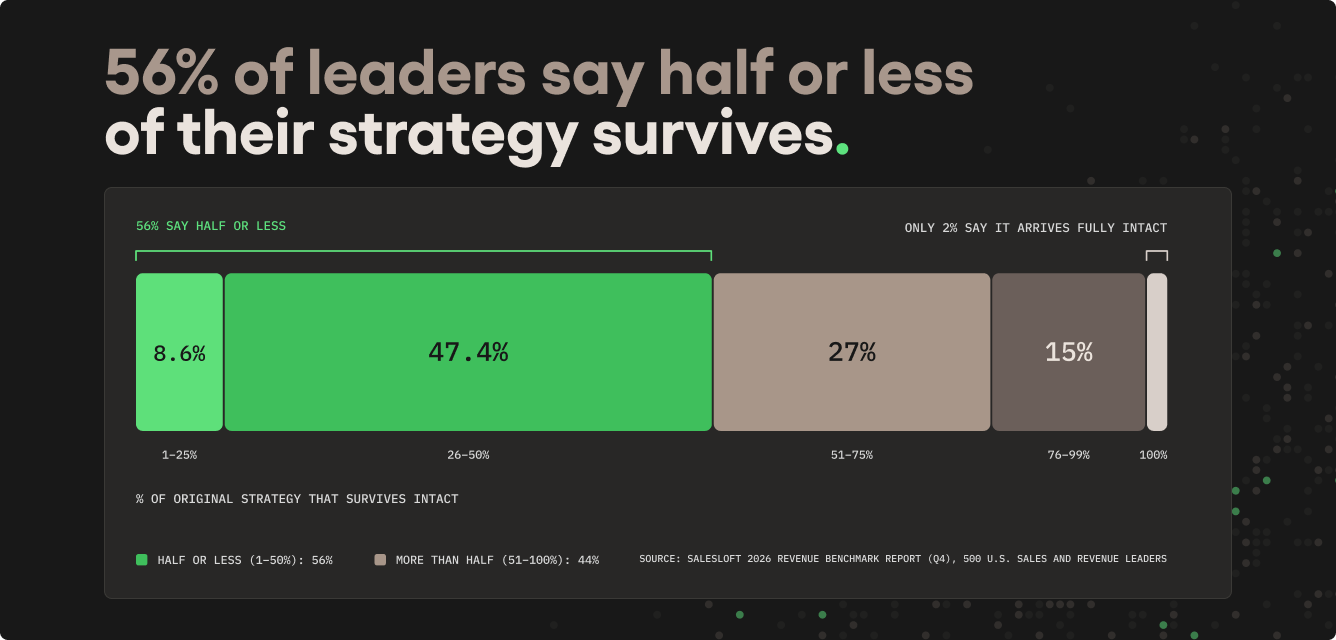
Source: Salesloft 2026 Revenue Benchmark Report, a survey of 500 U.S. sales and revenue leaders.
The decisions that shape a revenue strategy
Some of those choices in your revenue strategy are broad, such as which markets to pursue and how much pipeline the business needs. Other choices shape the day-to-day work, like which accounts deserve attention, how teams engage buyers and customers, how risk is managed, and where people and technology are deployed.
The strategy begins with leadership, but it is carried out much farther down the organization, through managers, sellers, and customer teams making hundreds of decisions along the way.
Build your strategy on real-time revenue intelligence
You can only build your strategy off the information you have at the time, but the feedback loop between strategy and execution is often too slow. Pipeline changes, target markets shift, products get updated, and sellers constantly pressure-test messaging with buyers. Decisions based on data that’s even a few weeks old can steer the whole revenue strategy off course.
According to Cameron Schuette, Product Marketing Director at Salesloft, most teams already have plenty of data. But they don’t have the ability to use that data in real time, which leads to a reactive approach and strategy changes.
“Most teams review pipeline health and seller performance at the end of a quarter, after a lost deal, or when a rep misses their quota. But the opportunity has already passed, so by the time those learnings are implemented, the market, deal, and quarter have already shifted,” she says.
Salesloft's 2026 Revenue Benchmark Report reveals the potential downstream effects of using revenue intelligence reactively. Fortunately, revenue teams have several ways to turn that same data into something sellers and leaders can act on in the moment.
| What Salesloft’s 2026 Revenue Benchmark Report found | The opportunity for your revenue strategy |
|---|---|
| Only 31% can instantly compare current pipeline with a prior period. | Instant, accurate comparisons of pipeline across periods give your revenue strategy a stronger foundation for forecasting |
| Only ~32% of leaders can instantly diagnose why a deal has stalled | Knowing the real reason a deal stalled means your strategy can include tactics that address the real roadblocks |
| 19.7% of pipeline affected by execution breakdowns | A reliable, up-to-date pipeline means you can catch issues like a stalled deal or a slipping close date, reducing the chance of costly execution failures impacting revenue |
How a Predictive Revenue System keeps strategy and execution connected
A Predictive Revenue System is one connected system that understands what is happening in the revenue process, acts on it, and learns from the result. Think of it as a continuous loop: activity leads to outcomes, outcomes update the forecast, and the forecast drives the next action.
That loop addresses the problem the benchmark data points to. When leaders can only see pipeline health at quarter-end, the strategy drifts before anyone can correct it. When activity, outcomes, and the forecast sit in one connected view, leaders can tell whether a gap comes from the strategy or from execution while there’s still time to respond.
Salesloft’s 2026 Revenue Benchmark Report found that only about 32% of revenue leaders can instantly diagnose why a deal has stalled, and only 31% can instantly compare current pipeline with a prior period. These are the visibility gaps a predictive revenue system is built to close.
A reliable pipeline can strengthen your strategy
Better revenue intelligence lets leaders see where execution diverges from the plan, diagnose why, and decide whether to update the strategy or correct the execution. This helps them spot revenue risk while the outcome can still change.
Start by examining pipeline intel that’s specific enough to act on. Look at high-level signals such as pipeline coverage against quotas, stage-to-stage conversion rates, and how long deals are sitting at each stage compared to a typical deal cycle.
Knowing the health of each pipeline stage lets revenue leaders point their teams to activities with the most impact. “That could mean prospecting to build more pipeline or spending more time closing deals already in motion,” Cameron says.
Identify pipeline problems at the deal level
High-level pipeline visibility is a starting point, but leaders and managers also need to quickly spot trouble at the deal level. This helps them diagnose the pipeline problem before prescribing a fix.
Flag things like a buying group missing a key stakeholder, a champion who’s gone quiet, a close date that’s been pushed more than once, or reps overcommitting to deals that always slip at the last minute. “A $100,000 deal with real buy-in is worth more attention than a $500,000 deal that’s already lost,” Cameron explains.
Being able to spot those signals, especially if they show up across multiple reps or accounts, helps leaders create a strategy that addresses those issues systemically.
Know what’s changing beneath the forecast
When the signals covered above feed directly into the revenue strategy’s forecast, teams don’t have to wait until quarter-end to find out whether pipeline will translate into meeting revenue goals. The underlying data reflects live rep and deal activity instead of a snapshot from weeks ago, so the forecast becomes more reliable and actionable.
For example, when a risk or a gap shows up, like a stage that’s thinning out or a deal that’s stalled, the forecast can also suggest next best actions in the seller workflow to keep everything on track.
Coaching to support your strategy
Spotting signals and forecasting are only part of the job. Reps still need real-time coaching on what to do, and basing that coaching on what star sellers are already doing can boost everyone’s performance.
Our 2026 Revenue Benchmark Report found that the top 10% of sellers bring in 47.4% of closed-won revenue. Leaders need to quickly identify what those top reps do differently and make it standard practice for the rest of the team. AI can help make that possible.
For example, an AI agent can flag when a rep is struggling with objection handling, then trigger a workflow that helps the seller improve their technique. If this becomes a trend across the team, the agent can diagnose the skill gap and initiate a department-wide play to close the gap based on what works for top reps.
Want a closer look at how AI-powered coaching works in practice? Check out The AI Sales Coaching Playbook .
A changing strategy isn’t the problem
Revenue strategies are always shifting. Markets move, forecasts change, and deals slip. That’s normal.
What the benchmark data shows happening at scale is different. Strategies fall apart because they were built on information that arrived too late to act on. “Sales teams don’t have the insights they need, with the right next action, while a deal is moving. That’s the difference-maker,” says Cameron.
Revenue intelligence gives leaders the fast feedback they need to distinguish between a strategy that needs to change and an execution problem that needs fixing, all while there’s still time to address feedback.
Learn what revenue leaders are seeing across pipeline generation, forecasting, seller performance, coaching, AI, and more. Read the 2026 Revenue Benchmark Report today.