
Sellers Who Personalize Most of Their Emails Get 2.8x the Replies
An analysis of 338 million sales cadence emails by Salesloft from January to September 2026 found that sellers who personalized the majority of their emails received 2.8 times more replies compared to those who did not personalize their outreach.
Blog Post
Sellers Who Personalize Most of Their Emails Get 2.8x the Replies
Published: November 13, 2026
Share this article:


Most cadence emails go out with no personalization on record. Of the 338 million cadence emails Salesloft analyzed from January through September 2026, fewer than one in 20 were personalized, and about three in four sellers personalized fewer than one in 10 of theirs. Sellers who personalized most of their emails, meaning 75% or more, got about three replies for every 100 sent, against about one for sellers who did none, a gap of 2.8x.
How personalization affects email reply rates
Salesloft sorted each seller's month by the share of cadence emails that were personalized, then counted the replies. The email reply rate rose at every step. A seller didn't have to go all in: one or two emails in every 10 produced 198 replies per 10,000 emails, nearly double the baseline of 105, while the 1% to 9% group saw only a small lift.
| Share of emails personalized | Replies per 10,000 emails | Compared with none |
|---|---|---|
| None | 105 | Baseline |
| 1% to 9% | 119 | 1.1x |
| 10% to 24% (one or two in 10) | 198 | 1.9x |
| 25% to 49% | 235 | 2.2x |
| 50% to 74% | 242 | 2.3x |
| 75% to 100% (most) | 296 | 2.8x |
Replies per 10,000 cadence emails, by personalization level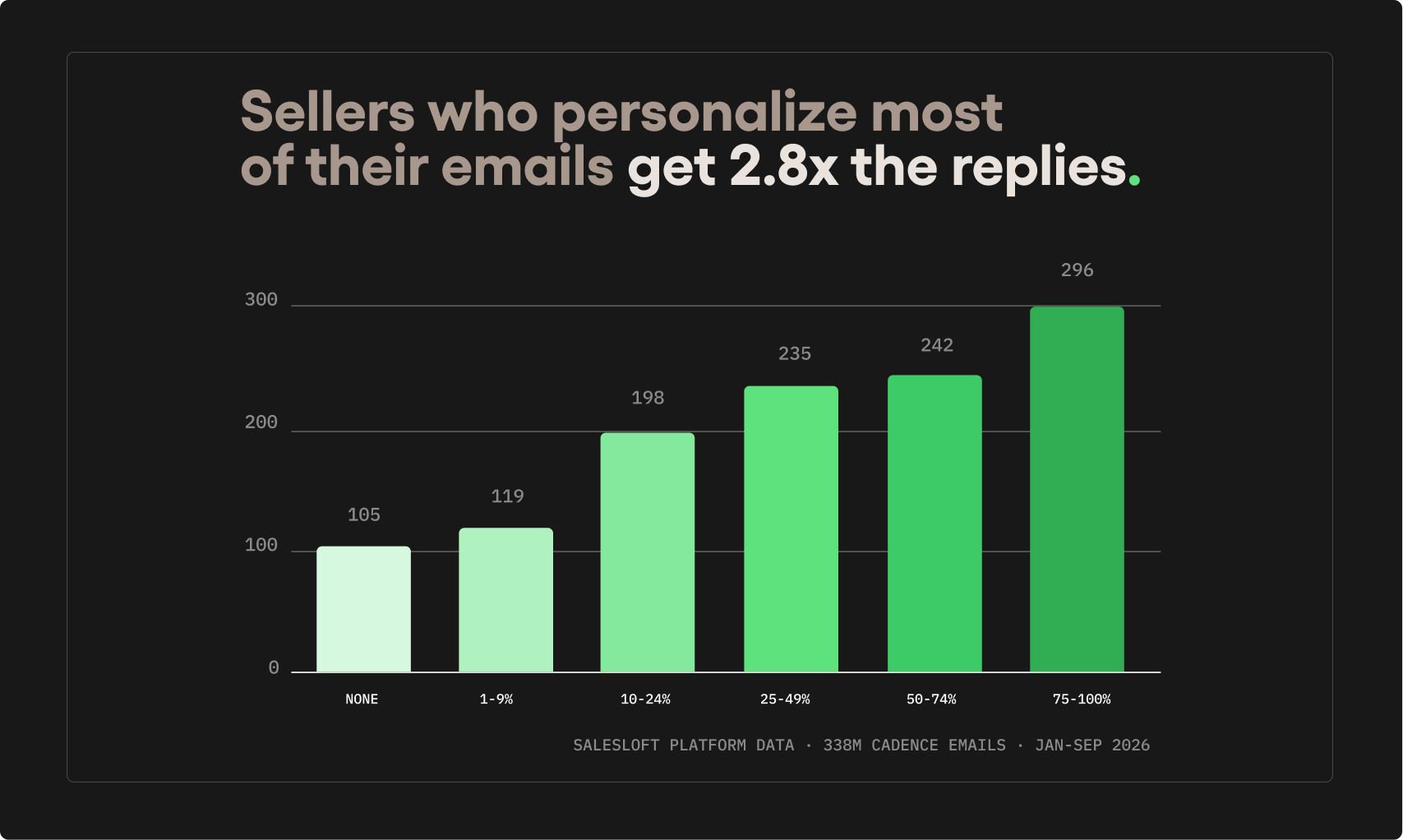
The trade-off is volume. Sellers who personalized most of their emails sent about a quarter as many a month as sellers who personalized none, roughly 300 against 1,200.
Personalization and replies: the same seller month to month
Sellers who personalize heavily may differ from the rest in other ways, so Salesloft also compared sellers with themselves. The 8,015 sellers in this group personalized a lot in some months and barely at all in others, and they got more replies in the heavier months.
| Months | Replies per 10,000 emails |
|---|---|
| Under 10% personalized | 136 |
| 25% or more personalized | 197 |
| Difference | 1.5x |
Same sellers, different months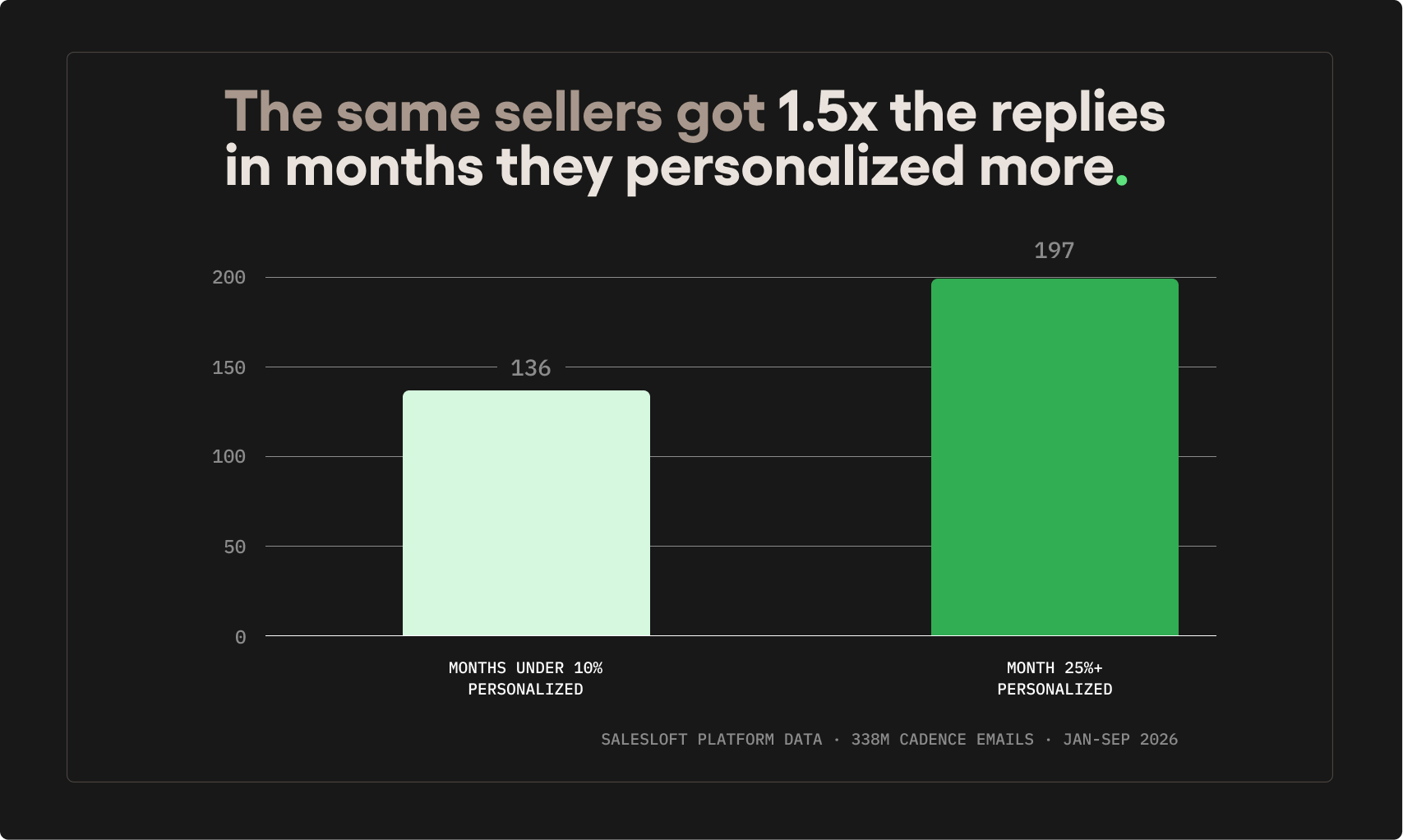
Does personalization reduce email bounce rates?
Yes. About 6% of emails bounced for sellers who did none, against about 4.5% for sellers who did most.
How much should you personalize sales emails?
Tips for sales leaders
- Get every seller off zero. One or two emails in every 10 was enough for nearly twice the replies, and replies kept rising as the share went up, so treat that as the floor, not the ceiling.
- Aim the deepest effort at top accounts. The sellers who personalized most of their emails sent far fewer of them, so reserve that depth for the accounts that matter most.
Tips for sellers
Start with at least one email in every 10, and spend your deepest effort on the accounts you most want to win. Pairing that with calls is another lever: sellers who call with every email book 4.4x the meetings.
Frequently asked questions
Does personalization improve email reply rates?
In Salesloft's data, sellers who personalized more of their emails got more replies, and the pattern held when the same sellers were compared month to month. The results show a relationship, not proof of cause.
What counts as a personalized email here?
The platform's record that a cadence email was customized before it was sent. One-off emails outside a cadence aren't included.
About this data
Salesloft analyzed anonymized, aggregated platform activity covering 338 million cadence emails from 65,413 sellers, counting only months in which a seller sent at least 50. Cadence emails are those sent as a step in a Salesloft cadence, and no company, seller or prospect can be identified. Reply rate is replies divided by emails sent. Salesloft repeated the analysis with the typical seller instead of the total and saw the same pattern.